

The Internal Revenue Service’s lack of a clear antifraud strategy is costing the federal government upwards of $116 billion a year, according to a recent congressional watchdog report.
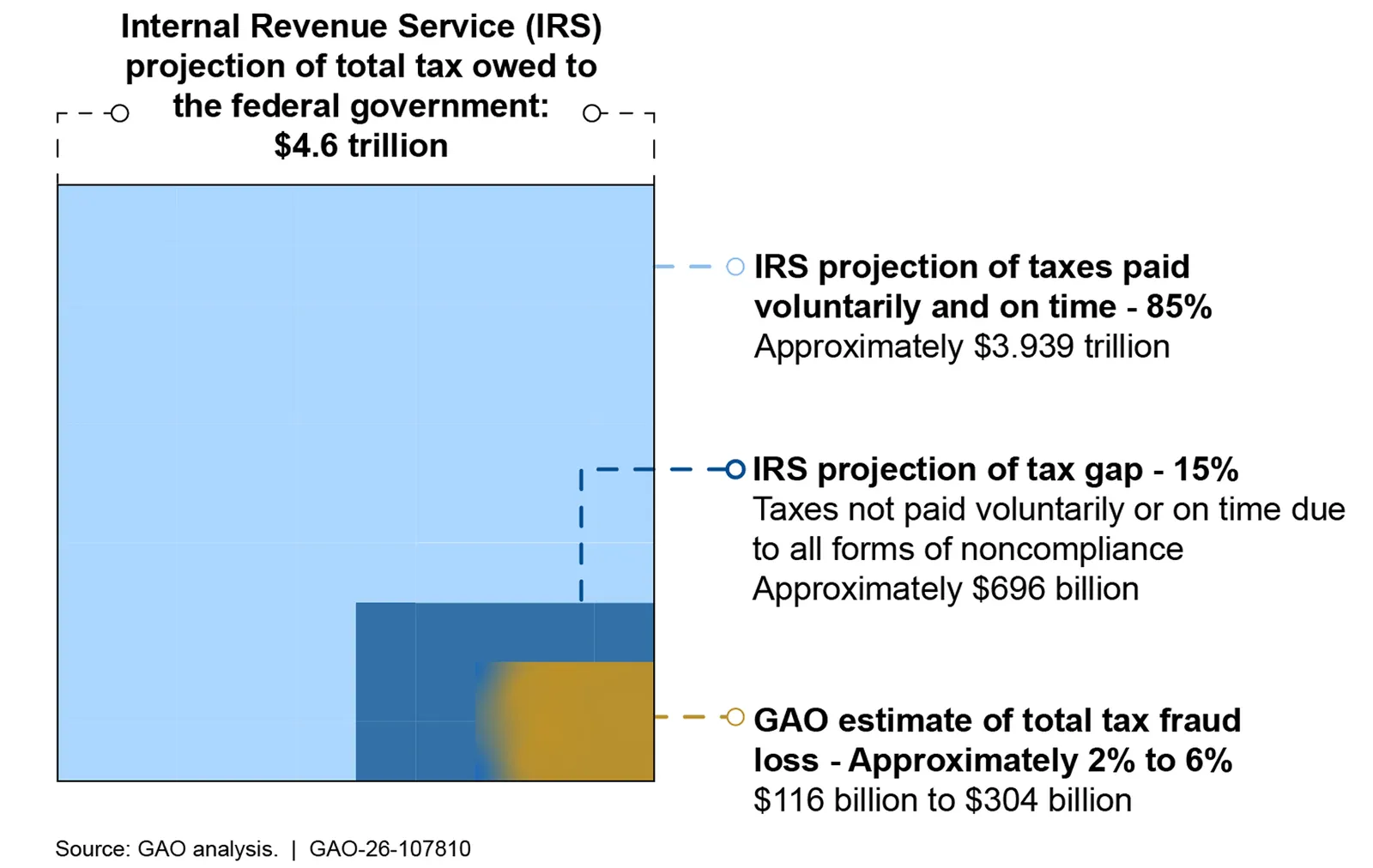
In a report issued Sept. 25, the U.S. Government Accountability Office estimated that federal tax fraud leads to a loss of about $116 billion to $304 billion a year, based on data from 2018 to 2024. The GAO said its projection is based on “cases of fraud and potential fraud, potential fraud in the tax gap, and tax evasion from economic activities purposefully hidden from the government (i.e., shadow economy).”
The loss figures amount to between 2% and 6% of the estimated $4.6 trillion owed to the federal government in the tax year 2022, according to GAO.
The watchdog report noted that the IRS has “routinely assessed fraud risks consistent with leading practices for fraud risk management.”
“However, the agency has not developed an antifraud strategy or designated an antifraud entity to mitigate fraud risks in a strategic and coordinated manner,” the GAO report stated. “An antifraud strategy could help IRS better manage fraud risks, which in turn could help reduce revenue lost to tax fraud. Further, designating an antifraud entity to undertake key fraud risk management activities—such as coordinating antifraud initiatives across the agency—would help IRS better mitigate the billions of dollars lost to fraud each year.”
To arrive at its tax fraud estimates, GAO said it used a statistical method known as a Monte Carlo simulation, which “attempts to capture uncertainty using repeated random sampling to identify the likelihood of a range of results occurring.”
GAO recommended that the IRS “develop and document an antifraud strategy and designate an antifraud entity.” IRS leaders said they agreed with both recommendations in part. The agency said it will “consider developing an agency wide antifraud strategy,” though it noted that it already “manages tax fraud across multiple divisions with a central focus within the Chief Tax Compliance Officer,” a role currently held by Jarod Koopman.
Frank Bisignano, the IRS’s chief executive, said that “additional analysis would be helpful to demonstrate how greater centralization would materially improve outcomes given the IRS’s existing high level of tax fraud risk coverage.” He also said GAO would need to “provide evidence that the potential benefits would outweigh the associated operational costs.”
Bisignano appeared to take issue with GAO’s characterization of fraud.
“The IRS is concerned that the report does not sufficiently distinguish fraud with broader taxpayer noncompliance, resulting in conclusions that do not fully reflect the IRS's approach to addressing these issues,” he wrote. “While the report includes examples of adjudicated fraud cases, it also characterizes a broader range of noncompliance cases as fraud. Instances of noncompliance, such as underreported income or inaccurate reporting, do not necessarily meet the legal threshold for fraud.”
In its report, GAO said that its estimate and reporting “decouple fraud from other forms of noncompliance.”
The office also noted that until now, there has not been a “comprehensive estimate of the amount of U.S. federal tax revenue lost to fraud.”
The IRS has, however, issued several reports over the last couple of decades estimating the wider tax gap, which encompasses all taxes not paid voluntarily or on time due to “all forms of noncompliance.” For the 2022 tax year, that was estimated to be $696 billion. GAO estimated that tax fraud loss would amount to anywhere from 17% to 43% of the gross tax gap for that year.
Any projection of tax fraud loss is, in some respects, something of a guessing game. “Fraud is difficult to quantify,” said Kathy Enstrom, chief operating officer and director of investigations at the Chicago-based Moore Tax Law Group, which was not involved in the GAO’s research.
“Part of the problem with putting out a number on this is that there are a lot of unknowns,” she told CFO.com, noting that criminals continue to find “new and inventive ways” to commit fraud. “As soon as you identify one way they are successful, then they change and start again.”
And as Bisignano’s comments showed, there’s not always a uniform agreement on what even constitutes fraud. “The definition of fraud can be interpreted quite differently by many different people,” Enstrom said.