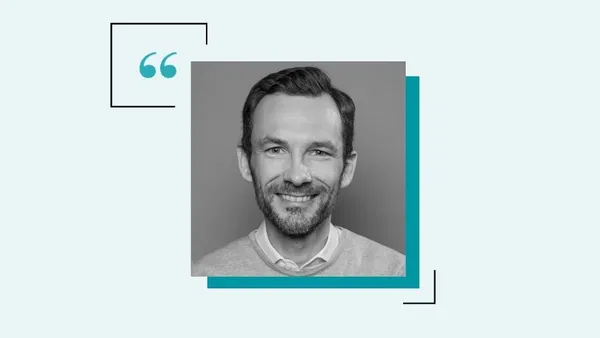


In an era where search engines and chatbots can help book business trips, the business of travel agencies may seem like a quaint relic of the past. But Mark Imrie, a nearly two-decade-long veteran of the game, is a firm believer in the model.
As CFO of Flight Centre Travel Group Americas, he’s steering the finances of a firm that ranks among the world’s largest remaining travel companies by revenue, and he maintains it’s the way to go for businesses these days. “One of the advantages of working with the fifth-largest travel company in the world is the pure scale, the depth of inventory and the buying power that we have with carriers,” he says. “If you’re trying to do this yourself and manage a program by yourself, you just don’t have that luxury.”
Imrie first joined the company’s Australian parent firm in Brisbane as an assistant manager of corporate finance back in 2010. An opportunity to work on the company’s student travel arm brought him over to Boston in 2017. He became CFO of Flight Centre’s Americas division by 2021.
At a time when finance departments are weighing the value of in-person business trips and airfare remains stubbornly elevated, Imrie is no less bullish on the sector. In an interview with CFO.com, he talks through his path from Australia to the United States, his firm’s “blueprint” for managing airfare and where he’s most recently traveled for work.

Mark Imrie
CFO, Flight Centre Travel Group Americas
First CFO position: April 2021
Notable previous employers:
- Grant Thornton Australia
- Crowe Horwath Australia
Editor’s note: This interview has been edited for brevity and clarity.
DAN NIEPOW: You were born in the U.K. and grew up in Australia, where you earned your master’s degree in applied finance and banking. How’d you end up in the U.S.?
MARK IMRIE: After I graduated from college, I spent about a decade working in Brisbane. I had a few years in audit, a few years in business services and tax, and then had an opportunity to work for Flight Centre Travel Group in their global headquarters. Then, being at a large global travel company, I had some opportunities to move around and travel abroad. I was fortunate enough to be given an opportunity to move over here to the Americas business, and that was in it was in late 2017. I’ve been here ever since, and it’s been quite a journey.
How would you say the accounting fields differ in Australia and the United States?
I think the core discipline is certainly very similar, but obviously there are different frameworks that govern the industry in each country. We have International Financial Reporting Standards, or IFRS, in Australia, and GAAP here in the U.S.
Having worked across Australia, the U.S., Canada and Mexico does really give an appreciation of all the reporting nuances that sit underneath a CFO title. It all looks the same on paper, but once you get into a specific region, country or state, it looks very different.
You’ve worked with Flight Centre Travel Group for more than 15 years now. How would you say the business has changed over that time?
I'll start by just saying that we're now the fifth largest travel company in the world, and you don't get to that size and scale without significant evolution.
Over the last 20 years, the biggest shift has been diversification of our business. Previously, we were a predominantly leisure travel-focused business, and we transacted largely through the old shop front in strip malls and travel shops.
We've now become a very diversified portfolio of travel businesses. We not only continue to transact and trade in leisure, but we also have a really large corporate business. We also dabble in a bit of touring and foreign exchange.
The other significant change is in customer preferences and how they interact with technology and book travel. We’ve also had to adapt, and we’re a lot more technology led, whereas previously it was all about the human-to-human consultant. The travel agent. Now we're definitely trying to essentially merge the two in the sense that we’re investing a lot in our technology platform, but while keeping the personal human element of travel core to our offering, as well.
Are you personally traveling much for work? When and where was your last trip?
If you ask my family, they’ll say I travel way too much. But in all seriousness, when you're CFO of a region that spans the vastness of the U.S.A. and parts of Canada and Mexico, I think it's critical that I spend a lot of time on the road.
I'm a tremendous believer in the power of business travel and connection. For me, it's about being face to face and helping businesses solve problems face to face. I was just in New York for our 401(k) committee meeting. The prior week I was in Montreal hosting my finance leadership group for some annual planning, and then I’m off to London for a few days with the global finance leadership team. I do travel a fair bit.
In the wake of COVID and widespread adoption of virtual work, corporate travel remains in flux. SAP Concur’s annual survey in 2025 found that 43% of CFOs believe that over half of their company’s business travel could be replaced by “teleconferences or other non-travel means of connecting.” How, then, do you make the case for corporate travel to your fellow CFOs these days?
I'm not sure I'd agree that corporate travel remains in flux. Certainly, if we look at our business performance and what our clients are spending on travel, I struggle to make the argument that it's in flux. In fact, I think it's very much back and growing very strongly. If you look at the airlines and their quarterly releases, they all talk about the growth and the strength of their corporate business and the business traveler. We're talking, you know, high single-digit, sometimes even double-digit revenue growth each quarter, in some cases.
I’m a massive believer in the power of business travel and the role that it plays in driving growth and solving problems. Based on the numbers that we transact and book for our customers, I think that's a fairly common view now. Maybe after COVID there was a bit of a softening, but I do think a lot of that has sort of subsided.
More and more companies are embracing the idea that it's important to spend time face to face, working with suppliers, creating new business ideas, solving problems. I'd encourage CFOs to not just treat travel as a cost line. Rather, it's an investment.
In environments where there are increasing airfare costs, it becomes about how you manage a bit more sensibly, and not necessarily about reducing the number of trips. That’s one of the reasons our subsidiary Corporate Traveler is releasing a blueprint on managing airfare costs.
Tell us a bit more about that blueprint. What else motivated the company to release this now, and what do you hope to accomplish with it?
It was widely publicized that airfares in August were up 23% over the same month last year. For anyone in the CFO seat, it's a pretty hard cost to ignore, and a pretty significant increase. We still genuinely believe in the importance of business travel, so we felt it was the right time to talk about how to manage costs. These are seven strategies that we encourage and work with our customers to adopt. There’s a way to do this and manage costs sensibly.
We’re also moving into an era of increased instability in many corners as a result of wars and other geopolitical tensions. What can companies do to ensure employees’ safety on a business trip?
Duty of care and employee safety is a pretty obvious responsibility of any company, but I also think it goes beyond that. For us, it's important that our clients and companies have absolute visibility over when and where their employees are at any one time, but also have plans in place if anything happens. We have a clear communication process, risk mitigation processes, disaster recovery, etc.
I think that’s why we encourage our people to work with travel management companies. We can take some of that heavy lifting off their shoulders so they can focus on growing their business.