

As companies race to incorporate artificial intelligence into their workflows, many finance teams still don’t have a clear window into the precise return on investment of the technology.
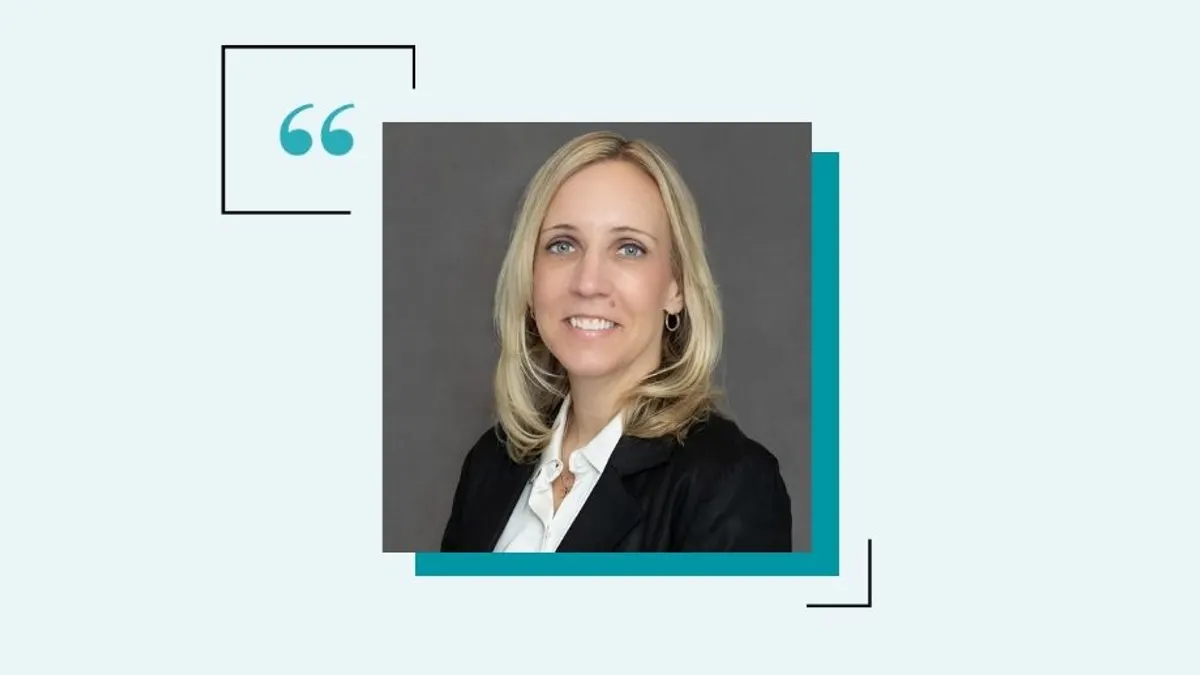
In an attempt to answer that lingering question, OpenAI CFO Sarah Friar in a Friday blog post laid out a four-part process for arriving at what she termed “the ultimate scorecard for the age of AI.”
In Friar’s view, the “basic economic question facing CFOs” is “whether the value of the work AI completes grows faster than the cost of producing it.” To answer that question, Friar suggests that business leaders first quantify what exactly completion means for a given workflow and then calculating the cost of using an AI tool to solve it.
Next, companies can track a tool’s “dependability” by tallying how often it produced a result that met quality standards, how often it required human edits and how often it required a person to step in and finish the task.
Finally, Friar suggested businesses continue to track each workflow over time. Friar wrote that her suggestions are aimed at helping businesses calculate “useful intelligence per dollar.”
“A lower-cost model may have cheaper tokens, but getting great results may require more attempts, more time, or more human review,” she wrote. “A more capable model may have more expensive tokens, but complete the same task in one pass. What matters is the full cost of producing a successful outcome, measured against the value that outcome creates.”
Changing roster
The blog post comes as Friar is taking on additional responsibilities after Fidji Simo, the company's second-ranking executive, announced she is stepping down from her full-time role following an extended medical leave.
According to The Wall Street Journal, her product and business responsibilities will be divided among Friar, President Greg Brockman and Chief Strategy Officer Jason Kwon as OpenAI prepares for a potential initial public offering while expanding its enterprise business and competing more aggressively with Anthropic.
Friar’s new responsibilities will likely have her taking on a much more public-facing role in representing the company to prospective B2B customers.
Simo, who oversaw finance and was the executive to whom Friar reported, told employees Thursday that her worsening neuroimmune condition would require a longer recovery than anticipated and said she would transition to a part-time adviser.
The leadership change follows a series of executive transitions at OpenAI this year. Simo began a medical leave in April, and Chief Marketing Officer Kate Rouch also stepped away from the company for cancer treatment earlier this year.
Vice President of Science Kevin Weil, Sora lead Bill Peebles and CTO of B2B Applications Srinivas Narayanan departed in April as OpenAI decentralized its science research and wound down development of its standalone Sora video application. The exits followed former Chief Technology Officer Mira Murati's departure in late 2024, when she said she wanted time for "personal exploration."
The move also renewed attention on an April report by The Information that Friar had privately questioned OpenAI’s aggressive compute spending strategy and expressed concerns about whether the company would be ready for an initial public offering as early as this year.
OpenAI disputed those reported claims in a rare joint statement from Altman and Friar in April, saying the two executives were "fully aligned" on the company's infrastructure strategy and had both been "directly involved in every consequential compute decision over the past year plus." Notably, Altman and Friar’s note called The Information’s reporting “ridiculous”.
Expanding finance’s size and scope
As OpenAI's infrastructure investments accelerated, Friar also expanded the scope of the finance organization itself.
Speaking during an OpenAI webcast in June, she said the company had built a finance team of roughly 200 people while broadening its responsibilities beyond accounting and financial reporting. The organization includes pricing and economic research teams alongside more traditional finance functions, reflecting how OpenAI views finance as part of its broader business strategy.
“Today I have an economic research team. I have a pricing team,” Friar said. “These often will not sit in the CFO's world because the CFO is overloaded with all the other things.”
Friar also described an organization increasingly using OpenAI's own technology across day-to-day finance operations. “We are really going AI native in the finance world,” she said. “Our tax team is probably our most AI-pilled team,” Friar said.