


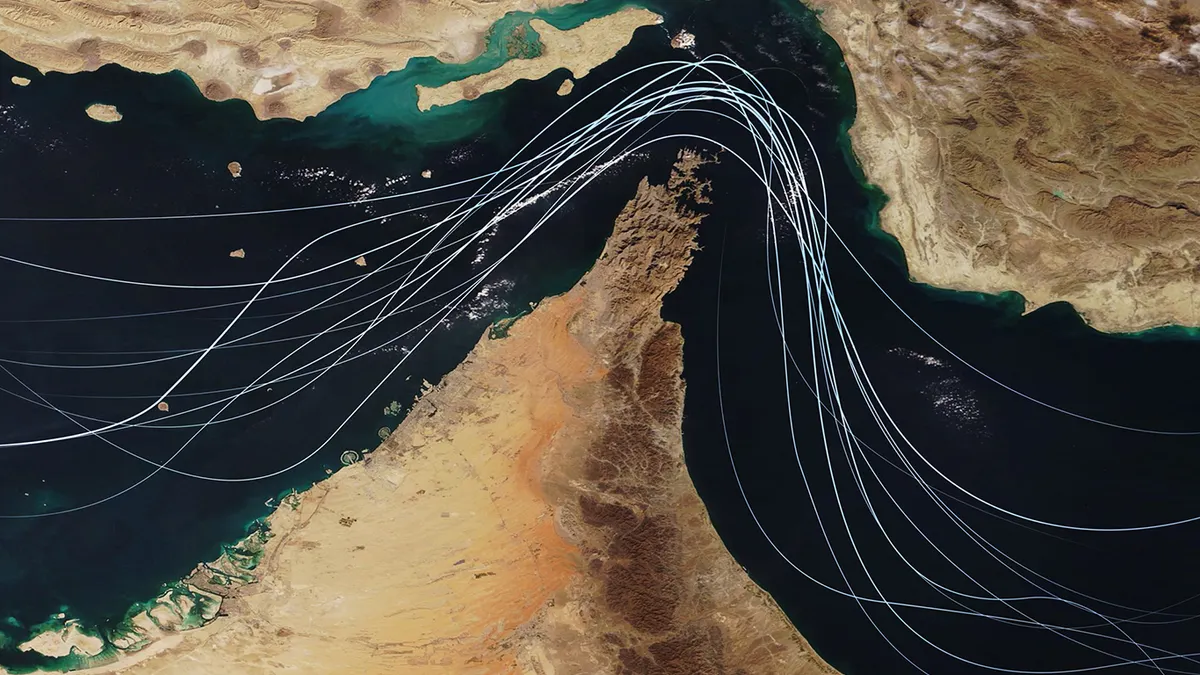
American oil and gas executives don’t anticipate a quick resolution to the traffic jam caused by dueling blockades in the Strait of Hormuz.
That’s according to a survey of executives from 120 oil and gas firms conducted this month by the Federal Reserve Bank of Dallas. A majority of respondents (79%) said they don’t expect traffic in the Strait to return to normal levels until August at the earliest. Of that subset, 39% predicted normal traffic would resume by August, while 26% said that wouldn’t happen until November.
Even if normal traffic resumes, executives surveyed by the Dallas Fed aren’t entirely convinced it’ll stay that way. Just about half of respondents (48%) believe that “geopolitical events” are “very likely” to disrupt the strait’s traffic within the next five years. Another 38% believe such events are “somewhat likely” to disrupt traffic over the same time period, while 14% said such disruptions are unlikely.
Anonymous comments gathered in the Dallas Fed survey added more detail to the level of uncertainty many energy execs say they’re facing.
“The geopolitical events are too chaotic to provide any degree of certainty to commodity pricing or unimpeded transportation through the Strait of Hormuz at this time,” read one comment from an oil exploration and production executive. “I am of the opinion that the costs related to shipping oil from the Persian Gulf will increase, but by how much I am not sure.”
On the latter point about pricing, that executive was not alone, with most survey respondents indicating that shipping costs from the region will increase even after the conflict winds down. When asked how much they expected such costs to grow after the war’s end, 36% of participants expected them to grow by more than $2 per barrel but not more than $4, according to the survey. That was the most picked answer. Another 23% expected Persian Gulf shipping costs to bump up by more than $6 per barrel.
At the same time, most respondents (70%) anticipate an uptick in U.S. oil production in 2027 as a result of the war in Iran.
The Dallas Fed’s survey took place April 15-20, just before Iran submitted another proposal to end the war and reopen the strait. American officials do not appear ready to accept that proposal.
In total, the bank said it received responses from 120 energy firms headquartered in Texas, southern New Mexico and northern Louisiana, and that many participants have national and global operations.
The survey’s top-line finding on projected timelines for the Strait of Hormuz traffic likely won’t come as a surprise to other executives in the energy industry. Ahmed Moghal, CFO of Houston-based oilfield services firm Baker Hughes, last week told investors that his company’s financial guidance assumes the U.S.-Iran conflict will last until the end of June and that the strait may not fully reopen until the second half of the year.
“There’s still a great deal of uncertainty regarding, ultimately, the duration and depth of the conflict,” Moghal was quoted as saying by CNBC.
In the Dallas Fed survey, one anonymous comment from an executive at an oil and gas services firm said that the shipping crisis in the Strait of Hormuz has, in part, turned “our 12-month projections into logistical jigsaw puzzles.”