


WESTMINSTER, Colorado — Whether the latest artificial intelligence tools deliver their makers’ promised economic and productivity gains in the long run is an open question. But it’s true that in the short term, the AI sector is doing some heavy lifting for the U.S. economy, for better or worse.
By one economic forecasting firm’s calculations, the American economy may well have entered recession territory absent the massive influx of capital flowing into the development of artificial intelligence.
That’s among the takeaways from a recent analysis by independent economic forecasting firm Oxford Economics.
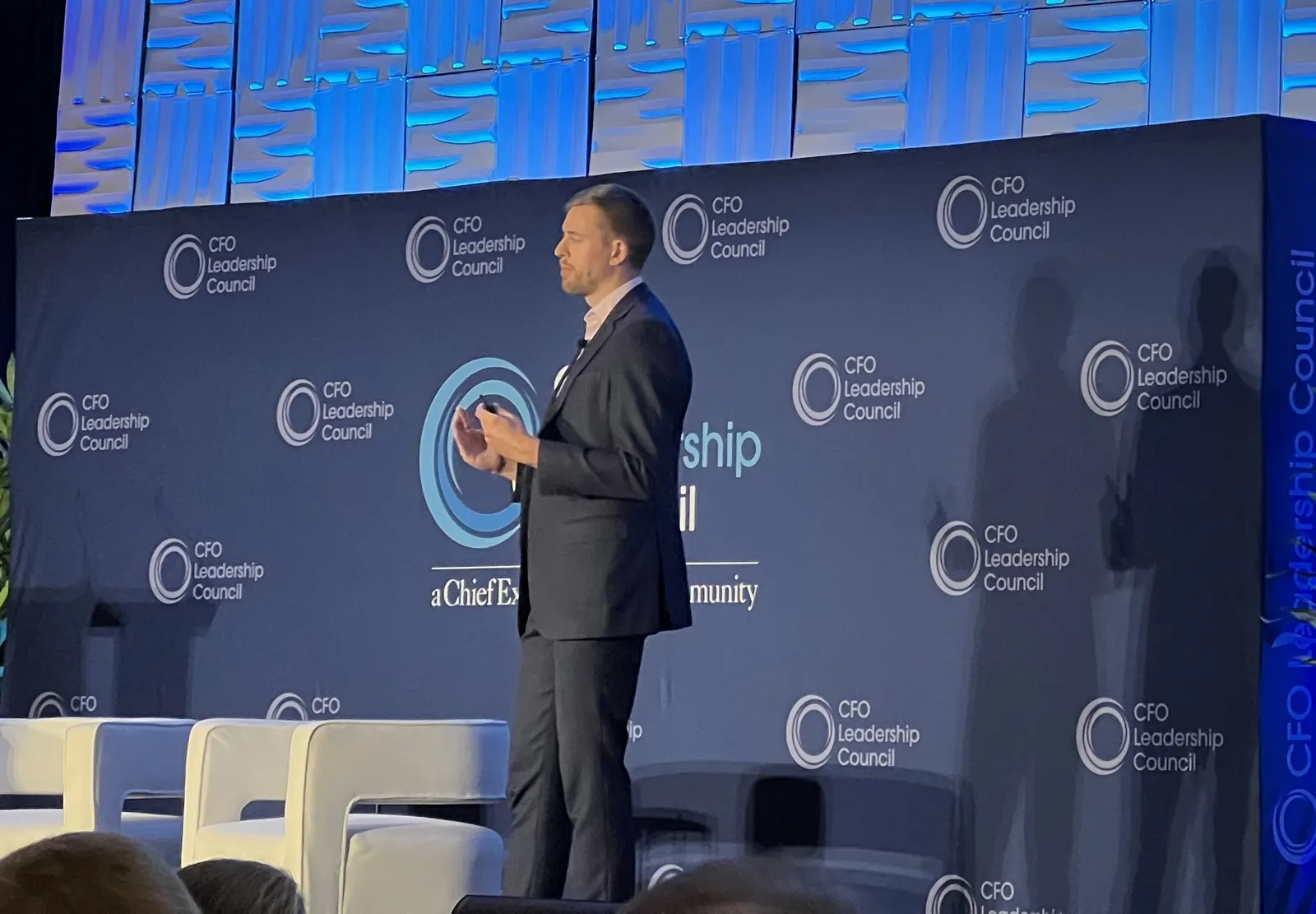
“All the growth in the past couple years has been in AI,” said Michael Pearce, chief U.S. economist at Oxford Economics. “Everything else has been falling two to three years.” It’s a scenario he described as “essentially a recession in non-AI categories.”
Pearce delivered his remarks at the CFO Leadership Council’s fall conference in Colorado last week, where vendors hawked a range of AI-enabled products. While he cautioned that in economics, there is rarely one thing that sums up the state of the economy, he maintained that the U.S. has seen something of a rebound driven by AI-related investment and higher-income consumer spending.
“While we are in a period of slowdown in the last couple of years, really what we’ve seen in the past six months or so has actually been a rebound,” he told attendees. “The economy is actually strengthening.”
By his firm’s calculations, the U.S. economy expanded by about 2% to 2.5% over the first half of the year, and is likely to expand by “something north of 3%” in the third quarter.
Though Pearce maintained there will be an “AI tailwind for quite some time,” he acknowledged that the AI boom likely won’t benefit all companies equally. As he put it, there are “definite signs this technology is creating winners and losers.”
His presentation came just one day after Character.ai, a popular AI companion startup founded by two former Google employees, filed for Chapter 11 bankruptcy protection. Per court filings, the once-promising company was spending as much as $8 million to $9 million per month and had not achieved profitability. The startup also faces a string of lawsuits claiming that its technology drove users to harm themselves, among other allegations.
Character.ai is, of course, just one anecdote, and it’s not operating at the same scale as big-name tech companies like Google or Meta. It’s not clear if other AI startups will meet the same fate.
But at a time when investors continue to worry more loudly about a potential “bubble” in the AI space, Character.ai’s fall is not exactly a comforting sign. Even the CEO of a major semiconductor maker recently acknowledged at a Singapore conference that some investor bets on AI endeavors are like casino gambling. Meanwhile, the CEO of global asset managing giant BlackRock last week told CNBC that a moratorium on new data center construction could lead to a recession, reaffirming the notion that the U.S. economy is still heavily dependent on AI sector spending.
Still, it’s also worth noting that past historic booms have also been associated with several business failures, Pearce pointed out. Ditto for the circular financing that’s become the hallmark of the AI industry. “It’s not unusual in historic booms,” he said. “We’ve seen that sort of arrangement in the past. … It just makes the whole system more vulnerable to one weak link in a chain.”
He also maintained that the AI sector is ultimately “still in early stages,” with a “surprisingly low” adoption rate so far. In an optimistic scenario for the new tech, adoption rates, productivity levels and economic output could all rise in the years ahead.
“The economy is becoming more productive; we’re just not capturing it in real time,” Pearce said. “The fruits of this boom might not be fully obvious.”